


How many business decisions in Port of Spain or San Fernando are currently being steered by skewed data from poorly phrased questions? Most local leaders recognize that while raw data is abundant, capturing the nuance of the Trinidadian consumer requires more than just a digital questionnaire. You’ve likely experienced the frustration of low response rates or the inability to translate raw percentages into a cohesive market entry plan. Mastering survey design and analysis Trinidad requires a blend of global statistical rigor and deep regional cultural intelligence to ensure your findings are both valid and representative.
This guide provides the professional framework you need to transform raw Caribbean data into actionable strategic insights. We’ll outline a methodical approach to creating surveys that generate statistically significant results your stakeholders can trust. By the end of this article, you’ll understand how to navigate local demographic challenges and the evolving regulatory environment, including the principles of the Data Protection Act 2011, to drive successful market entry or CSR initiatives. It’s time to move beyond simple data collection and start building a foundation for reliable business intelligence.
Key Takeaways
- Learn the fundamental distinction between superficial polling and scientific instrument design to ensure your data objectives align with corporate strategy.
- Master a repeatable framework for survey design and analysis Trinidad that navigates local demographic nuances and multi-channel data collection.
- Discover how to bypass regional gatekeeper cultures through a strategic mix of digital, telephone, and face-to-face methodologies.
- Transition from basic descriptive statistics to inferential analysis, providing your board with the high-level business intelligence required for market entry.
- Understand how specialized local expertise in STEM and CSR project management adds a layer of depth to raw data that generic international firms often overlook.
Foundations of Professional Survey Design and Analysis
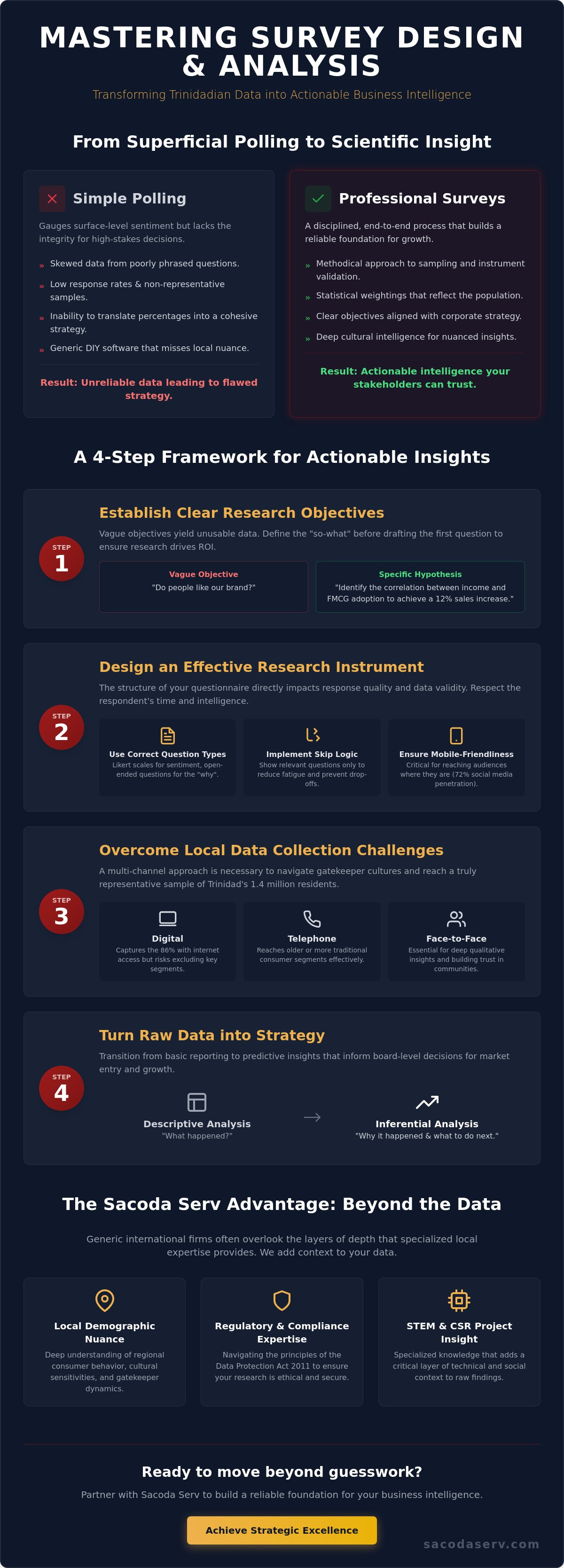
Professional research in the Caribbean requires a departure from the casual gathering of opinions. Many local organizations mistake a simple social media poll for rigorous scientific inquiry. While a poll might gauge surface-level sentiment regarding a new product launch in Port of Spain, it lacks the structural integrity required to inform high-stakes capital allocation. True survey design and analysis Trinidad involves a disciplined approach to sampling, instrument validation, and statistical weightings that reflect the 1.4 million residents of our twin-island republic. This methodology ensures that the data you collect is not just a snapshot of a moment, but a reliable foundation for long-term business consulting services.
Survey vs. Questionnaire: Why the Distinction Matters
Understanding the technical difference between these terms is central to the foundations of survey methodology. A questionnaire is merely the physical or digital instrument used to collect data. The survey, however, encompasses the entire end-to-end process: from defining the target population to the final analysis of respondent behavior. Professional design ensures the instrument isn’t compromised by leading questions or double-barreled items that confuse participants. When you align the instrument with strategic goals, you move beyond “nice-to-know” facts and toward data that supports your internal strategic initiatives.
Establishing Clear Research Objectives
Vague objectives lead to unusable data. Instead of asking “do people like our brand?”, a professional researcher formulates specific hypotheses. In the current economic climate, where real GDP growth is estimated at 0.7% for 2026, every dollar spent on research must yield a return. You must determine the “so-what” before the first question is drafted. For instance, if you’re analyzing consumer confidence in the non-energy sector, your data should directly influence your 2026 distribution strategy. The primary research objective is to identify the correlation between household income levels in Chaguanas and the adoption of health-oriented FMCG products to achieve a 12% increase in regional sales conversion.
Relying on generic DIY survey software often leads to significant data gaps in the local context. These platforms don’t account for the unique demographic layers of the Caribbean or the specific gatekeeper dynamics found in Trinidadian corporate structures. Professional survey design and analysis Trinidad requires identifying the correct stakeholders and defining a representative target population before any data collection begins. Without this level of precision, your findings may be skewed by the 86% internet penetration rate, potentially excluding older or more traditional consumer segments that require telephone or face-to-face methodologies to reach effectively. Grounding your research in strategic market insights Trinidad professionals rely on ensures your objectives are calibrated to the documented 6 to 12-month lag between energy price shifts and local household spending patterns.
Step-by-Step: Designing an Effective Research Instrument
Designing a research instrument is a technical exercise that requires more than just listing questions. It serves as the bridge between your strategic objectives and the data you’ll eventually analyze. In the context of survey design and analysis Trinidad, the structure of your instrument directly impacts your response quality. You must select question types that match your goals. Likert scales provide measurable sentiment, while open-ended questions offer the qualitative depth necessary to understand the “why” behind consumer shifts. Using skip logic and branching isn’t just a technical perk; it’s a mark of respect for the respondent’s time. If a participant doesn’t own a vehicle, they shouldn’t see questions about fuel preferences. This efficiency reduces fatigue and prevents the “straight-lining” behavior that ruins data sets.
Trust is a currency that must be earned within the survey flow. Starting with sensitive demographic or economic questions often leads to immediate abandonment. Instead, draft a logical progression that builds rapport. Begin with general, easy-to-answer lifestyle questions that signal the survey’s relevance to the participant’s daily life. As the respondent becomes engaged, you can gradually transition into more specific inquiries. Ensuring the instrument is mobile-friendly is also critical. With social media penetration at 72% according to 2025 GSMA data, a significant portion of your audience will interact with your survey on a smartphone. A layout that’s difficult to navigate on a small screen will lead to high drop-off rates and skewed results. For organizations looking to implement these methodologies, engaging with expert Quantitative Research services ensures your instrument is calibrated for maximum engagement.
Question Construction and Bias Mitigation
Local research often encounters social desirability bias, where respondents provide answers they believe are “correct” or socially acceptable. To counter this, professional design uses neutral phrasing and avoids leading language. Phrasing sensitive economic questions requires care, especially when tracking the 6 to 12-month lag in consumer confidence following energy revenue shifts. Pilot testing with a local sample is non-negotiable. It allows you to catch linguistic nuances or cultural interpretations that a generic template would miss.
Sampling Strategies for the Caribbean Market
A common pitfall in small island states is assuming a convenience sample in Port of Spain represents the entire nation. Adhering to statistical standards for survey planning requires a more disciplined approach. You must decide between probability and non-probability sampling based on your risk tolerance. Stratified random sampling is often the most effective method here. It ensures representation across key geographic corridors, including the East-West Corridor and Central. Don’t forget Tobago. Including the sister island is essential for any survey design and analysis Trinidad project that claims to be truly national.
Implementation: Overcoming Local Data Collection Challenges
Executing a research project in the Caribbean requires a sophisticated understanding of local social dynamics. Moving from the theoretical phase of survey design and analysis Trinidad to actual data collection often reveals the “gatekeeper” culture prevalent in both corporate and household environments. In Port of Spain’s business districts, reaching a decision-maker often requires navigating multiple administrative layers. Similarly, in residential areas, a cold digital invitation might be ignored without a clear signal of trust or regional relevance. Overcoming these hurdles demands a multi-channel approach that combines digital outreach with telephone and face-to-face methodologies to ensure no demographic segment is overlooked.
Ethical considerations are paramount in 2026. While the Data Protection Act 2011 remains partially proclaimed, professional standards dictate that we operate as if the full weight of the law is in force. This means obtaining explicit consent and ensuring participants understand how their data will be used. Transparency isn’t just a legal requirement; it’s a strategic tool. When respondents feel their privacy is respected, they’re more likely to provide the honest, high-quality data necessary for meaningful Qualitative Research. Failure to address these local sensitivities can lead to “survey fatigue” and high abandonment rates that compromise your entire dataset.
Maximizing Response Rates in Trinidad and Tobago
Participation depends heavily on brand authority and perceived value. In the local market, generic incentives often fail to motivate high-value respondents. For B2B C-suite interviews, professional honorariums ranging from $150 to $400 USD per completed session are standard for ensuring engagement. Timing is equally critical. Attempting to collect data during the peak Carnival season, when annual spending exceeds $100 million USD and attention is elsewhere, often results in skewed or rushed responses. It’s better to schedule fieldwork during periods of relative economic stability to capture a more accurate reflection of consumer sentiment.
Quality Control in Fieldwork
Maintaining data integrity requires real-time monitoring of all field activities. “Lazy” responses or fraudulent entries can quickly contaminate a Caribbean dataset if left unchecked. We implement rigorous Quality Control protocols to catch outliers as they happen. For physical product performance, specialized retail auditing is essential. Our Retail InsighTT protocols provide a structured framework for field-based data accuracy, ensuring that what’s reported from the shelf matches the reality of the marketplace. This level of scrutiny transforms raw field notes into the reliable business intelligence that stakeholders demand for market entry or CSR initiatives.
Analysis and Interpretation: Turning Raw Data into Strategy
The transition from raw information to strategic business intelligence is the most critical phase of survey design and analysis Trinidad. Raw data, while abundant, is often a liability if processed without a rigorous analytical framework. In Caribbean datasets, data cleaning must address the specific anomalies of our market. Missing values often occur due to the “gatekeeper” dynamics and privacy concerns discussed in previous sections. Outliers in spending data, for instance, frequently reflect the extreme seasonality of the local economy, particularly the $100 million USD annual Carnival expenditure. Identifying these nuances prevents skewed results that could lead to costly miscalculations in market entry or CSR planning.
When presenting to a board of directors, the distinction between descriptive and inferential statistics is vital. Descriptive statistics provide a snapshot of what happened, such as the mean satisfaction score or the percentage of respondents in Chaguanas who use a specific service. However, institutional clients require inferential statistics to understand the “why” and the “what next.” This level of analysis determines if a trend is statistically significant or merely a result of sampling error. To add another layer of depth, we utilize our Lifestyle Trends & Market Insight (LTMI) framework to contextualize these numbers within the broader socio-economic landscape of 2026. This ensures your dashboard tells a compelling regional story rather than just displaying isolated figures. To leverage these insights for your organization, explore our comprehensive Business Consulting Services.
Quantitative Analysis Techniques
Professional reporting goes beyond simple frequency tables. We use cross-tabulation to uncover hidden relationships between demographics and consumer behavior, such as how age correlates with the adoption of premium health-oriented FMCG products. It is essential to distinguish between correlation and causation to avoid common pitfalls in business reporting. Regression analysis utilizes historical energy revenue data and current consumer sentiment scores to predict 2026 discretionary spending shifts within the non-energy sector with a high degree of statistical confidence. This predictive capability allows for more precise capital allocation and risk management.
Qualitative Synthesis and Sentiment
Quantitative numbers tell you how many, but qualitative synthesis tells you why. We apply thematic analysis to open-ended feedback and focus group transcripts to identify emerging lifestyle trends that numbers alone might miss. This process bridges the gap between what people say in a survey and what they actually do in a retail environment. By integrating these findings with physical retail audits, we provide a holistic view of the market. This dual approach ensures that your strategy is grounded in both the expressed sentiment of the Trinidadian consumer and the hard reality of their purchasing behavior at the shelf.
Partnering with Sacoda Serv for Strategic Excellence
Generic international research firms often apply standardized templates that fail to account for the unique cultural and economic nuances of the Caribbean. While these firms may understand global statistical theory, they frequently lack the regional intelligence required to navigate the “gatekeeper” dynamics or the specific sampling challenges inherent in a 1.4 million population. Our approach to survey design and analysis Trinidad is rooted in decades of local expertise. We bridge the gap between raw data collection and high-level Business Consulting Services, ensuring that every insight is filtered through a deep understanding of the twin-island republic’s socio-economic landscape.
Data reaches its full potential only when it is integrated with specialized disciplines. By combining Quantitative Research with our established expertise in STEM and CSR consulting and Project Management, we help organizations measure social impact with the same precision as financial ROI. This integration is critical for institutional clients who must align with global ESG standards while maintaining local relevance. We don’t merely act as a data provider; we serve as a long-term strategic partner dedicated to transforming information into a competitive advantage. Our proprietary tools, such as Retail InsighTT and Lifestyle Trends & Market Insight (LTMI), provide a level of depth that generic software cannot replicate.
Bespoke Research vs. Off-the-Shelf Solutions
Off-the-shelf solutions often miss the granular details that drive success in the local market. Sacoda Serv tailors every research instrument to the specific objectives of the client, whether it involves navigating the logistics of Tobago fieldwork or analyzing consumer shifts in the non-energy sector. Our professional project management ensures that large-scale public sector surveys are executed with the rigor required for policy-level decision-making. We move beyond surface-level polling to deliver validated, representative data that withstands the scrutiny of corporate boards and international stakeholders.
Your Next Steps for Evidence-Based Growth
Initiating a research partnership in Port of Spain begins with a methodical consultation process. We start by defining the core business problem and identifying the specific KPIs that will measure success. From there, we move through the stages of instrument design, multi-channel data collection, and advanced inferential analysis. The final output is not just a report, but a strategic roadmap for growth. Schedule a consultation with Sacoda Serv to design your next survey and ensure your organization is led by evidence rather than assumption. By choosing a partner that understands the nuances of the Caribbean market, you secure the reliable business intelligence necessary for sustainable market entry and long-term success.
Elevate Your Business Intelligence with Regional Precision
Effective research is the difference between costly assumptions and strategic certainty. Mastering survey design and analysis Trinidad requires a disciplined approach to methodology, from the initial objective setting to the complex thematic analysis of local sentiment. By navigating the nuances of the Caribbean marketplace and adhering to global statistical standards, you build a foundation of trust with your stakeholders. Sacoda Serv brings specialized expertise to both private and public sector research through our proprietary Retail InsighTT and LTMI frameworks. Our strategic presence in Port of Spain, Georgetown, and Kingston ensures your data is grounded in regional reality.
Contact Sacoda Serv for Expert Survey Design and Analysis to begin your transition from raw information to actionable business intelligence. We’re ready to help you navigate these complexities and turn your data into a lasting competitive advantage.
Frequently Asked Questions
How much does a professional survey cost in Trinidad?
Professional survey costs vary significantly based on the sample size, methodology, and geographic scope of the project. While online surveys are generally more cost-effective, complex CAPI surveys or brand tracking studies require a higher investment due to fieldwork logistics and the depth of analysis required. We recommend a consultation to define your specific requirements, as variables like including Tobago or targeting C-suite executives will influence the total project budget.
What is the typical timeline for a market research survey in the Caribbean?
A comprehensive research project typically spans four to eight weeks from the initial design phase to the delivery of the final strategic report. This timeline allows for rigorous instrument testing, multi-channel data collection, and deep analytical interpretation of the results. Rushing the process often compromises data integrity, so we build in sufficient time for quality control and thematic analysis to ensure the findings are truly actionable for your stakeholders.
How do you ensure a representative sample in a multi-island nation?
We utilize stratified random sampling to ensure that the data accurately reflects the diversity of both Trinidad and Tobago. This involves dividing the population into groups based on key demographics and geographic corridors, such as the East-West Corridor, Central, and South. Including Tobago is essential for any national representation, though it requires specific logistical planning to account for the unique market conditions found on the sister island.
Can survey design help with Corporate Social Responsibility (CSR) impact measurement?
Scientific survey design is a critical tool for quantifying the effectiveness of CSR and STEM initiatives. By establishing baseline metrics before a project begins and conducting follow-up assessments, organizations can move beyond anecdotal evidence to report statistically significant social ROI. Our specialized consulting services integrate these research findings into your broader sustainability reporting to satisfy both local and international stakeholders.
What is the difference between Retail InsighTT and a standard survey?
Standard surveys capture expressed consumer sentiment, while Retail InsighTT focuses on observational data and physical retail audits. This proprietary framework measures actual product performance on the shelf, including pricing compliance, share of shelf, and inventory levels. By combining what consumers say in a survey with the hard reality of the retail environment, we provide a holistic view of the marketplace that sentiment alone cannot provide.
Is digital survey collection effective for the older demographic in T&T?
Digital methodologies are highly effective for the 86% of the population with internet access, but they often under-represent older or more traditional consumer segments. To ensure your survey design and analysis Trinidad project is truly inclusive, we often recommend a multi-channel approach. Combining digital links with telephone or face-to-face interviews helps capture the nuances of every demographic, preventing the bias that comes from an online-only sample.
How does Sacoda Serv protect respondent data and privacy?
We adhere to the core principles of the Data Protection Act 2011 and international best practices for research ethics. This includes obtaining informed consent from all participants and ensuring that data is collected for specified, transparent purposes. Even as local regulations evolve, our internal protocols prioritize confidentiality and data security to maintain the trust of the respondents and the integrity of your organization.
Can you help analyze data that we have already collected ourselves?
Our business consulting services include the analysis and interpretation of existing datasets to extract deeper strategic value. Many organizations possess raw data but lack the specialized tools or statistical expertise to identify significant trends or correlations. We can clean your data, apply inferential statistical models, and provide the high-level interpretation needed to turn those numbers into a cohesive business strategy.