


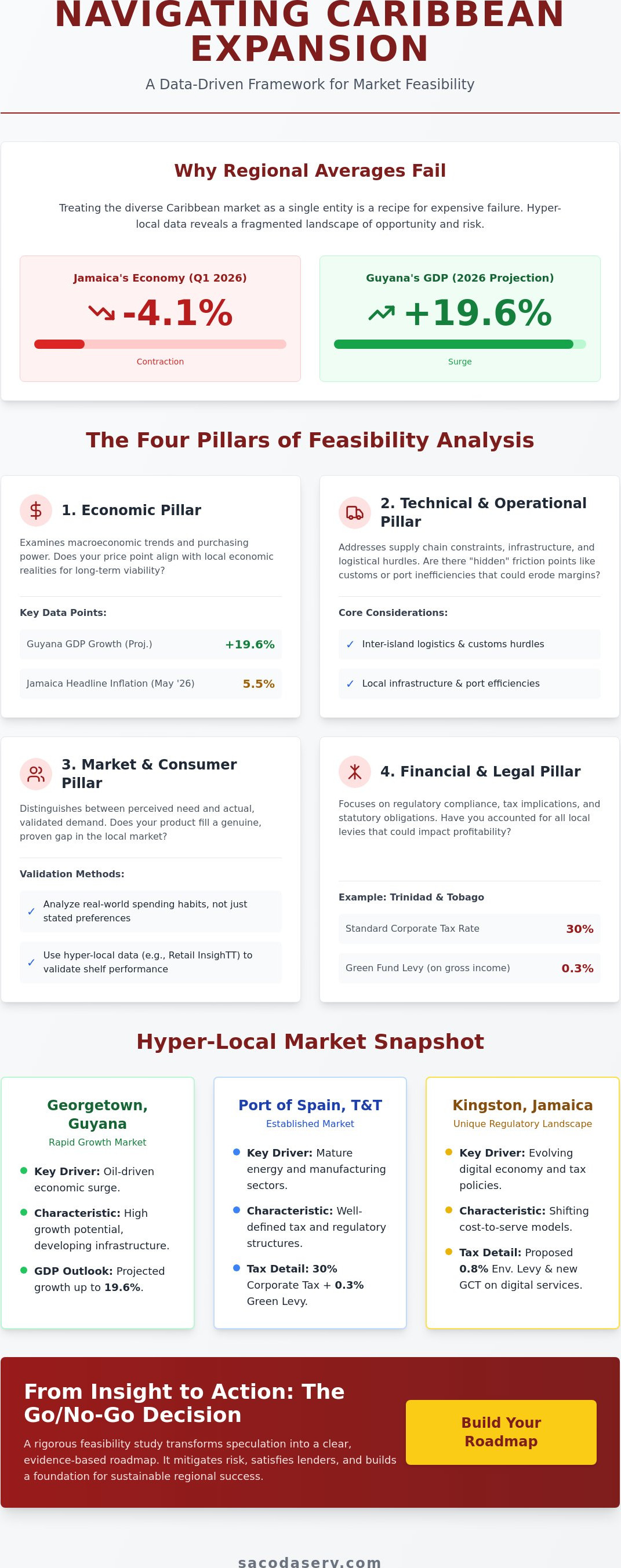
Why do so many ambitious regional expansions stall before they even reach the second island? In a landscape where Jamaica’s economy contracted 4.1% in early 2026 while Guyana’s GDP is projected to surge by up to 19.6%, treating the region as a single entity is a recipe for expensive failure. A rigorous market feasibility study Caribbean serves as more than a preliminary checklist; it’s a strategic necessity for any firm seeking to navigate the disparate regulatory environments and consumer habits of these unique territories. You understand that capital is too precious to risk on assumptions, and the lack of reliable, hyper-local data remains the greatest hurdle to your international growth.
This guide offers a data-driven framework to master the complexities of entry and validate business viability across fragmented markets. We’ll show you how to build an evidence-based foundation that satisfies institutional lenders and mitigates risk before you commit significant capital. By the end, you’ll have a clear roadmap for regional expansion, from understanding Trinidad and Tobago’s 3.50% repo rate to navigating the shifting tax landscapes in Kingston and Georgetown. Let’s move beyond raw information toward the actionable insights required for sustained regional success.
Key Takeaways
- Define feasibility as the intersection of economic viability, logistical reality, and consumer readiness to avoid the pitfalls of regional averages.
- Conduct a robust market feasibility study Caribbean by evaluating the four pillars of growth, specifically addressing purchasing power and localized supply chain constraints.
- Leverage Retail InsighTT and Lifestyle Trends & Market Insight (LTMI) to validate shelf performance and predict consumer adoption with hyper-local accuracy.
- Distinguish between the rapid growth in Georgetown, the established markets of Port of Spain, and the unique regulatory landscape of Kingston.
- Develop a structured go/no-go decision matrix to synthesize findings into a clear roadmap for sustainable regional expansion and risk mitigation.
Understanding Market Feasibility in the Caribbean Context
Market feasibility is the critical intersection where economic viability, logistical reality, and consumer readiness converge. For corporate leaders, it’s the difference between a calculated expansion and a costly retreat. In a region as diverse as ours, feasibility isn’t a generic check-box exercise; it’s a rigorous investigative process that determines if a specific business model can survive the unique pressures of a local territory.
Relying on regional “averages” often leads to failure because the Caribbean isn’t a monolith. A modest 1.1% growth forecast for the broader region in 2026 masks the fact that Guyana’s GDP is projected to climb by up to 19.6%, while Jamaica’s economy saw a 4.1% contraction in the first quarter of the same year. Entering Georgetown with a strategy built for Port of Spain ignores fundamental differences in tax structures, infrastructure, and purchasing power. A market feasibility study Caribbean provides the empirical evidence needed to de-risk capital investment before a single dollar is committed.
The Difference Between a Business Plan and a Feasibility Study
A business plan acts as a roadmap for execution, but a feasibility study serves as the essential validation tool that precedes it. While a plan details “how” you’ll operate, the study answers the more fundamental question: “should we enter at all?” Institutional investors and banks in Trinidad and Tobago typically demand this rigorous analysis to prove a project’s viability before they even look at an operational plan. It transforms speculative ideas into bankable assets by proving that the market demand actually exists.
Why Regional Fragmentation Demands Hyper-Local Data
Consumer behavior shifts dramatically between Kingston, Georgetown, and Port of Spain. In Jamaica, proposed increases in the Environmental Protection Levy to 0.8% and new GCT applications on digital services create a different cost-to-serve model than in Trinidad’s energy-mature market. Operational feasibility also hinges on varying import duties and logistics constraints that can erode margins overnight. When performing a market feasibility study Caribbean, we look beyond the surface to identify these specific island-to-island variances. Caribbean market feasibility is a localized validation of demand, supply, and regulatory fit. Without hyper-local data, your expansion strategy is little more than a guess.
The Four Pillars of a Comprehensive Caribbean Feasibility Analysis
A successful market feasibility study Caribbean rests on four foundational pillars. Each territory requires a bespoke evaluation to ensure that capital is deployed effectively. You cannot rely on a generic regional template when the economic and regulatory realities vary so significantly between neighbors.
The Economic Pillar examines regional macroeconomic trends and purchasing power parity. While Jamaica faces a 5.5% headline inflation rate as of May 2026, Guyana is navigating an oil-driven surge with GDP growth projected to reach up to 19.6%. You must determine if your price point aligns with these shifting local realities to ensure long-term viability.
The Technical and Operational Pillar addresses supply chain constraints and local infrastructure. Trinidad and Tobago maintains a mature energy and manufacturing infrastructure, but inter-island logistics involve complex customs hurdles and port efficiencies that can inflate operational costs. Understanding these “hidden” friction points is vital for accurate modeling.
The Market and Consumer Pillar distinguishes between perceived need and actual demand. Regional surveys often reveal that consumer spending habits don’t always mirror their stated preferences. We analyze real-world behavior to ensure your product or service fills a genuine gap in the market rather than an imagined one.
The Financial and Legal Pillar focuses on regulatory compliance and tax implications. In Trinidad and Tobago, for example, the standard corporate tax rate is 30%, and businesses must account for a 0.3% Green Fund Levy on gross income. Failing to account for these specific statutory obligations can turn a projected profit into a deficit.
Market Analysis: Beyond Desktop Research
Secondary data is often unreliable or outdated in the Caribbean region. Most online reports lack the granularity needed for high-stakes corporate decisions. Performing a market feasibility study Caribbean requires moving beyond surface-level statistics and engaging in primary data collection. Utilizing Quantitative Research and Qualitative Research allows you to capture ground-truth insights that desktop research simply cannot provide. For those seeking a deeper competitive advantage, integrating strategic market insights Trinidad ensures your data reflects the current 2026 retail landscape.
Operational Feasibility and Supply Chain Realities
Inter-island shipping and varying import duties create significant operational friction. A successful market entry strategy for Jamaica, for instance, requires an understanding of the proposed Environmental Protection Levy increase to 0.8% effective May 2026. Beyond logistics, you must evaluate labor market readiness for your specific industry needs. Technical feasibility often requires expert oversight, which is why we incorporate STEM and CSR consulting and Project Management into our operational audits to ensure your project can actually be built and maintained locally.
Data-Driven Validation: Using Retail and Lifestyle Insights
High-level economic indicators often fail to capture the granular reality of the shop floor. Validating a business model requires moving from broad GDP forecasts to the actual point of sale. This is where Retail InsighTT provides essential ground-truth data. By auditing shelf performance and competitor presence in real-time, we strip away the layers of corporate assumption. You see exactly how rival brands are positioned, how they are priced on the shelf, and how consumers interact with specific categories in a live retail environment.
Predicting consumer adoption goes beyond looking at current sales figures. Our Lifestyle Trends & Market Insight (LTMI) framework tracks shifting preferences across the region to identify emerging behaviors before they become mainstream. This foresight is a cornerstone of a robust market feasibility study Caribbean. It allows you to tailor your entry strategy to where the market is going, not just where it has been. By understanding these lifestyle shifts, businesses can align their offerings with the evolving values of the regional consumer.
Quantitative Research firms based in Trinidad and Tobago serve as the analytical backbone for these deep-dive studies. We employ a disciplined methodology to transform raw data into actionable business intelligence. This process involves rigorous data cleaning, multi-variate statistical analysis, and strategic interpretation by seasoned consultants. Integrating these retail metrics into a market feasibility study Caribbean ensures that your financial projections are grounded in physical reality rather than desktop estimates. This methodical approach builds the necessary trust with institutional lenders who require evidence of a project’s long-term stability.
Retail Audits as a Feasibility Barometer
Shelf monitoring reveals the true competitive landscape in local supermarkets across the islands. It identifies “white spaces” where consumer needs are currently unmet or underserved by existing regional and international brands. Tracking retail performance over time allows you to see seasonal fluctuations and stock-out frequencies that impact revenue. Beyond physical products, mystery shopping validates the feasibility of service-level standards. It tests whether your proposed operational model can actually be executed within the local labor and service culture of Port of Spain or Kingston.
Qualitative Insights: Understanding the Caribbean Consumer
While numbers provide the “what,” Qualitative Research reveals the “why.” Focus groups allow you to test product-market fit with actual consumers before a formal capital launch. These sessions uncover deep-seated perceptions that influence brand loyalty and purchasing habits. Using consumer perception studies helps refine your brand positioning to resonate with local cultural nuances and linguistic preferences. Qualitative data reveals the “why” behind Caribbean purchasing habits that numbers alone cannot capture. This layer of insight prevents the tone-deaf marketing mistakes that often plague foreign entrants.
Georgetown is currently the focal point of regional investment, with oil production reaching 900,000 barrels per day. This creates a “frontier” environment that contrasts sharply with the mature, energy-stabilized economy of Port of Spain. While Trinidad’s GDP growth is projected at 0.8% for 2026, the challenge there lies in market saturation rather than infrastructure deficits. A market feasibility study Caribbean must distinguish between these stages of economic evolution to provide a realistic entry timeline.
Kingston presents its own set of complexities. The 2026/2027 budget in Jamaica has introduced several fiscal adjustments, including the application of GCT to digital services from abroad and an increase in the Environmental Protection Levy to 0.8%. These regulatory shifts, combined with an economy that contracted 4.1% in the first quarter of 2026, require a feasibility framework that prioritizes fiscal resilience and adaptive pricing. A framework for multi-country entry must prioritize territories based on their fiscal stability and ease of doing business, rather than geographic proximity.
Many regional leaders view Miami as the logistical and strategic hub for Caribbean operations. It often serves as the consolidation point for supply chains and the headquarters for regional decision-makers. However, a feasibility study must account for the 10% baseline import duty imposed by the United States on many Caribbean goods. This tariff continues to be a significant challenge, forcing a reconsideration of trade dependencies for export-oriented models. Foreign Direct Investment is projected to reach 16.1 billion US dollars in 2026, and understanding these logistical flows is essential for capturing a share of that capital.
Guyana: The Frontier of Feasibility
Regional leaders frequently search for “how to enter the Guyana market” as they eye the projected 14% to 19.6% GDP growth for 2026. Success in Georgetown requires more than just capital; it demands a deep understanding of local content requirements and economic impact assessments. As oil wealth circulates, consumer lifestyles are shifting. Increased disposable income is creating demand for high-tech agribusiness and sophisticated services that didn’t exist five years ago.
Trinidad & Tobago: Navigating a Mature Competitive Landscape
In Trinidad, the focus shifts toward market segmentation. Saturated sectors like retail and banking require specialized research to identify underserved niches. Stakeholder engagement research is also vital, particularly for public-private partnerships where navigating the regulatory environment of the Central Bank and local ministries is essential. If your firm is ready to pivot or enter this established market, our strategic planning services Trinidad provide the data-driven foundation needed to compete effectively.
Implementing Insights: From Feasibility to Sustainable Market Entry
Translating a market feasibility study Caribbean into a concrete operational reality requires a disciplined transition from analysis to action. Once the data is gathered, the next phase involves synthesizing these insights into a go/no-go decision matrix. This tool allows leadership teams to evaluate whether the projected returns justify the inherent risks of regional expansion. It’s not just about identifying opportunities; it’s about determining if the risk profile aligns with your firm’s long-term stability.
Developing a risk mitigation plan is the natural progression of identifying operational hurdles. Whether it’s navigating the 30% corporate tax rate in Trinidad or the logistical friction of inter-island shipping, each hurdle needs a specific counter-strategy. A phased entry roadmap often proves most effective. This approach allows businesses to test their assumptions in smaller, controlled territories before scaling to larger, more complex markets like Guyana. Testing the model first helps protect your capital.
Successful execution depends on professional project management. Transitioning from a study to a launch isn’t a simple hand-off; it’s a continuous process of refinement. Using disciplined project management ensures that technical and operational feasibility remains intact as the business moves through various regulatory and logistical milestones. It keeps the transition from raw data to actionable business intelligence focused on results.
Securing Investment and Stakeholder Buy-In
Investment requires proof. Presenting a market feasibility study Caribbean to institutional lenders or private equity firms involves demonstrating a deep understanding of local market conditions. In Trinidad and Tobago, for instance, you must show how your model accounts for the prime lending rate, which stood at 7.57% as of June 2026. Evidence-based decision making is the only way to align internal leadership teams and external investors. Additionally, integrating a CSR consulting strategy into your entry plan builds essential brand equity and demonstrates a commitment to local development, which often facilitates smoother regulatory approvals.
Sacoda Serv: Your Methodical Partner in Caribbean Growth
Sacoda Serv brings over 15 years of regional expertise and proprietary data tools to your expansion project. We position ourselves as a collaborative partner for both private and public sector initiatives, providing the stability and reliability required for complex regional growth. Our team understands the nuances of the Caribbean landscape, from the energy-driven boom in Georgetown to the mature competitive environment in Port of Spain. We don’t offer one-size-fits-all products; we provide bespoke solutions grounded in accuracy. Consult with Sacoda Serv for your Caribbean Market Feasibility Study to ensure your next regional move is backed by data-driven confidence.
Charting a Sustainable Path to Regional Expansion
Success in this fragmented landscape depends on your ability to replace assumptions with empirical evidence. We’ve explored how a rigorous market feasibility study Caribbean serves as the primary tool for de-risking capital investment by analyzing the economic, technical, and regulatory nuances of each specific territory. Moving from broad regional averages toward hyper-local retail and lifestyle insights ensures your business model is validated against real-world demand and logistical constraints. This methodical approach transforms a speculative venture into a bankable asset.
Sacoda Serv provides the stability and specialized intelligence required to navigate these complexities with confidence. With over 15 years of Caribbean-wide research expertise, we employ proprietary Retail InsighTT and LTMI methodologies to deliver accuracy for both private and public sector projects. We invite you to Partner with Sacoda Serv for Expert Caribbean Market Feasibility Studies and transform raw information into a clear, actionable roadmap for growth. Your regional expansion represents a significant capital commitment; ensure it’s built on a foundation of professional, data-driven certainty.
Frequently Asked Questions
What is the average duration of a market feasibility study in the Caribbean?
A comprehensive market feasibility study Caribbean typically requires eight to twelve weeks for completion. This timeline allows for rigorous primary data collection, stakeholder interviews, and multi-territory analysis. Complex projects involving technical STEM assessments or extensive retail auditing may extend this period to ensure the high level of accuracy required for securing institutional financing or private equity.
How much does a professional feasibility study cost for a regional startup?
The investment for a professional feasibility study varies based on the number of territories analyzed and the depth of the quantitative research required. Factors such as the complexity of the local regulatory environment and the specific industry vertical influence the final scope. It’s best to focus on a customized engagement that targets your specific growth objectives rather than a generic, one-size-fits-all template.
Can I use a feasibility study from another region for the Caribbean market?
Utilizing data from different geographic regions is not advisable due to the Caribbean’s fragmented economic landscape. Each island operates under distinct tax codes, import duties, and consumer habits. A study from a mature market like North America won’t account for local nuances like Trinidad’s 0.6% business levy or Jamaica’s specific GCT applications on digital services and intangibles.
What are the most common reasons businesses fail feasibility tests in Trinidad?
Businesses often fail feasibility tests in Trinidad due to market saturation in established sectors and a failure to account for “hidden” operational costs. Overlooking the 0.3% Green Fund Levy on gross income or underestimating the prime lending rate, which was 7.57% in June 2026, can significantly erode projected margins. Lack of a clear niche in a mature competitive landscape remains a primary hurdle.
How does the Guyana energy boom affect market feasibility for non-oil sectors?
The oil-driven surge in Guyana, with GDP growth projected between 14% and 19.6% in 2026, creates massive opportunities for non-oil sectors like agribusiness and logistics. Increased disposable income is shifting consumer lifestyles toward premium services and high-tech solutions. A feasibility study must evaluate how these rapid economic shifts impact local labor costs and infrastructure availability for non-energy firms entering Georgetown.
What role does CSR play in a Caribbean market entry strategy?
CSR consulting acts as a strategic bridge for building local brand equity and securing a social license to operate in new territories. In the Caribbean, demonstrating a commitment to local development can facilitate smoother regulatory approvals and improve stakeholder relations. It’s an essential component of a sustainable entry strategy that goes beyond simple financial projections to ensure long-term community alignment.
Is primary data collection necessary if I have access to government census data?
Primary data collection is essential because government census data is frequently outdated or lacks the granularity needed for high-stakes corporate decisions. A market feasibility study Caribbean utilizing tools like Retail InsighTT provides ground-truth insights on current shelf performance and competitor pricing that static reports cannot capture. Relying solely on broad statistics increases the risk of entering a market based on historical assumptions.
How often should a feasibility study be updated for a multi-year project?
A feasibility study should be updated annually or whenever significant regulatory or fiscal changes occur in your target market. For instance, the 2026/2027 budget adjustments in Jamaica, which increased the Environmental Protection Levy to 0.8%, would necessitate a refresh of any existing operational models. Multi-year projects require a living document that adapts to shifting interest rates and regional trade policies.